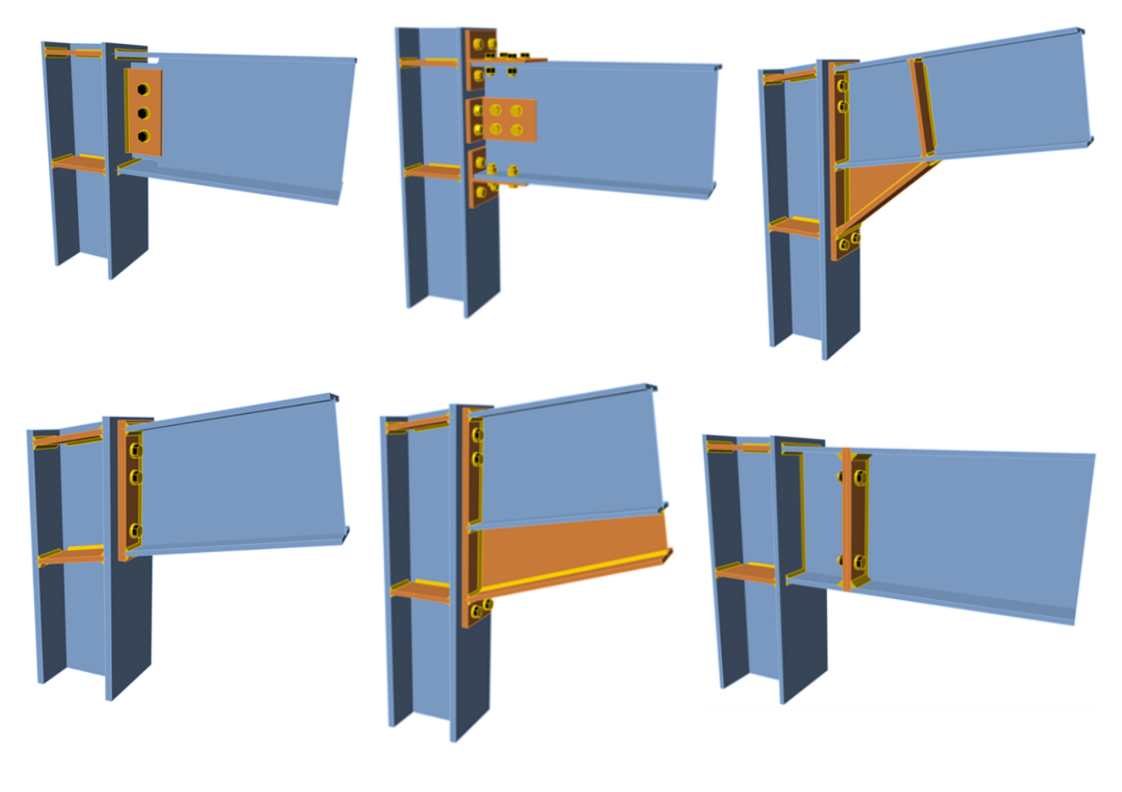
What Is a Moment Connection?
A moment connection is a joint that transmits bending moment forces between structural members or from a structure to its foundation, in addition to normal and shear forces. Moment connections appear in almost every structure but are most commonly found in transverse frames of steel halls, multi-story frames, and stiffening frames used as alternatives to bracing systems.

Classification of Moment Connections
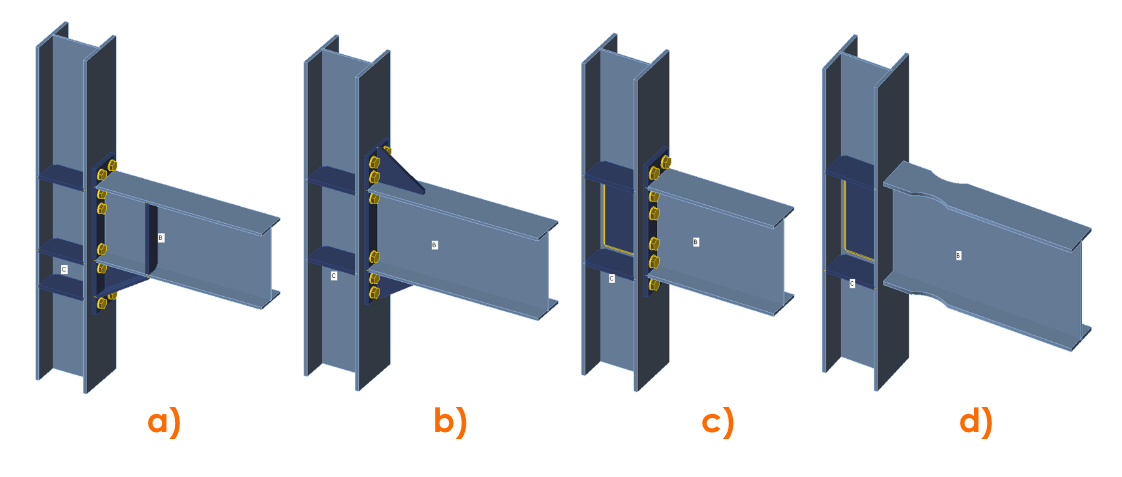
Moment connections are classified in several ways. By cross-section type: open sections, hollow sections, or combined. By connection elements: welded only, bolted only, or combined. By seismic application: seismic or non-seismic. By topology: full-depth end plate, extended end plate, stiffened extended end plate, haunched beam, and others.
Rigid connections are the most discussed moment connection type, but semi-rigid connections, also referred to as partially restrained connections, can also transfer significant bending moments and must not be overlooked. The stiffness of a moment connection is a critical design consideration.
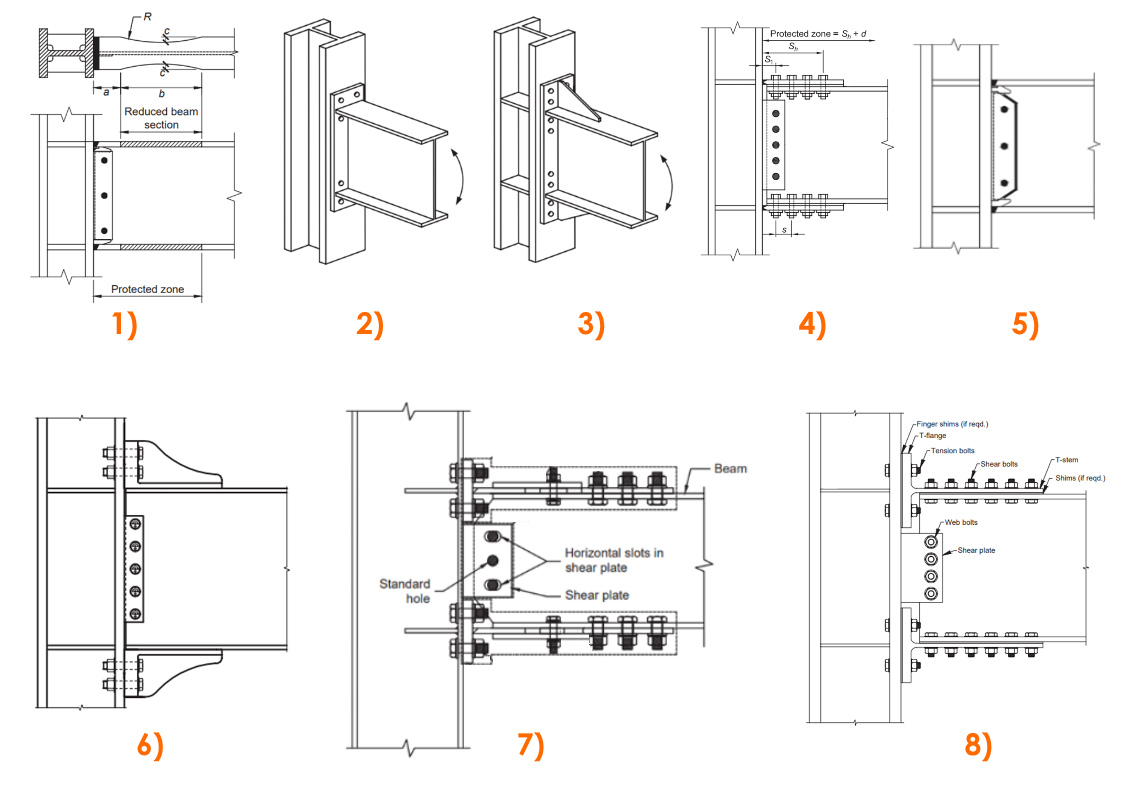
AISC Seismic Connections
In seismically active regions of the United States, structural lateral stiffness is typically provided by diagonal bracing, shear walls, or moment-resisting frames (MRF). AISC prequalified connections for moment-resisting frames are specified in ANSI/AISC 358-16. Common prequalified types include the reduced beam section (RBS), bolted unstiffened extended end plate (BUEEP), bolted stiffened extended end plate (BSEEP), bolted flange plate (BFP), welded unreinforced flange welded web (WUF-W), Kaiser bolted bracket (KBB), Simpson Strong-Tie Strong Frame, and double-tee connections.
Moment Connections for Hollow Sections
Moment connections using hollow sections are available in several configurations, including continuous beam over HSS column, through-plate, cut-out or collared plate, welded tee flange, end plate, diaphragm plate, and directly welded types. While HSS members are generally not allowed in prequalified seismic connections, an exception exists for the SidePlate moment connection types.
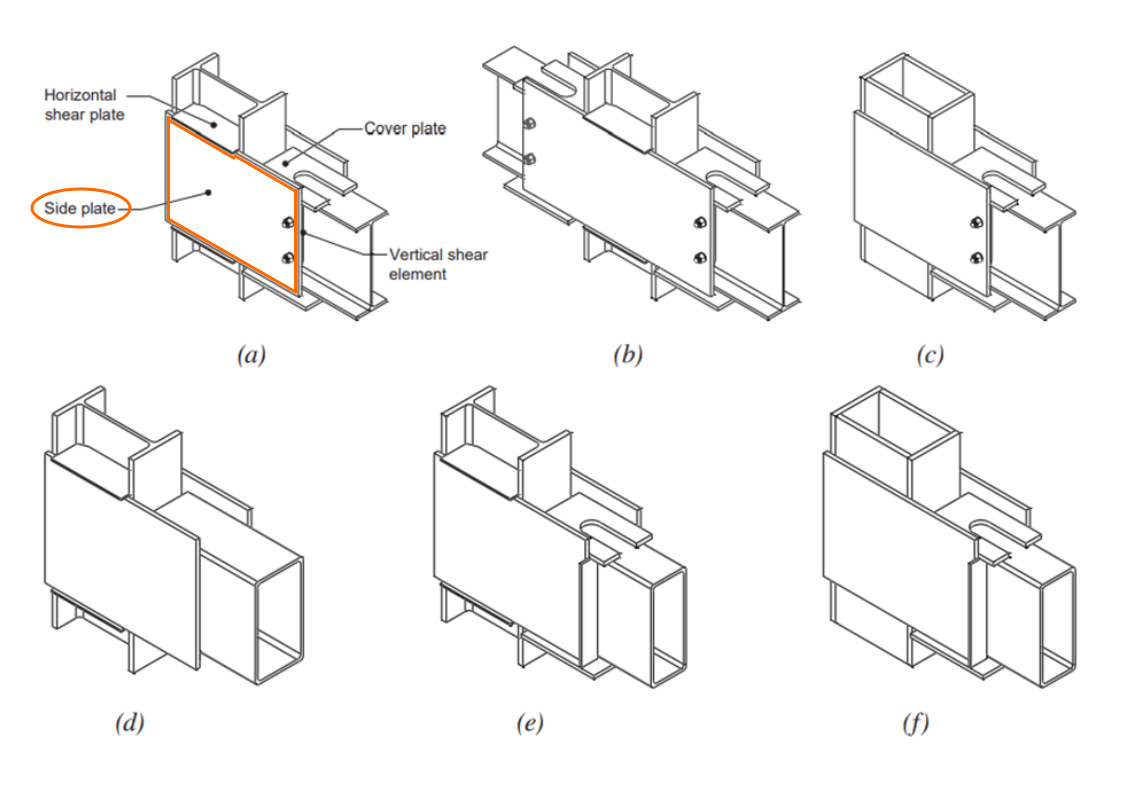
IDEA StatiCa Connection includes templates for these configurations, including those that are rarely used or geometrically complex.
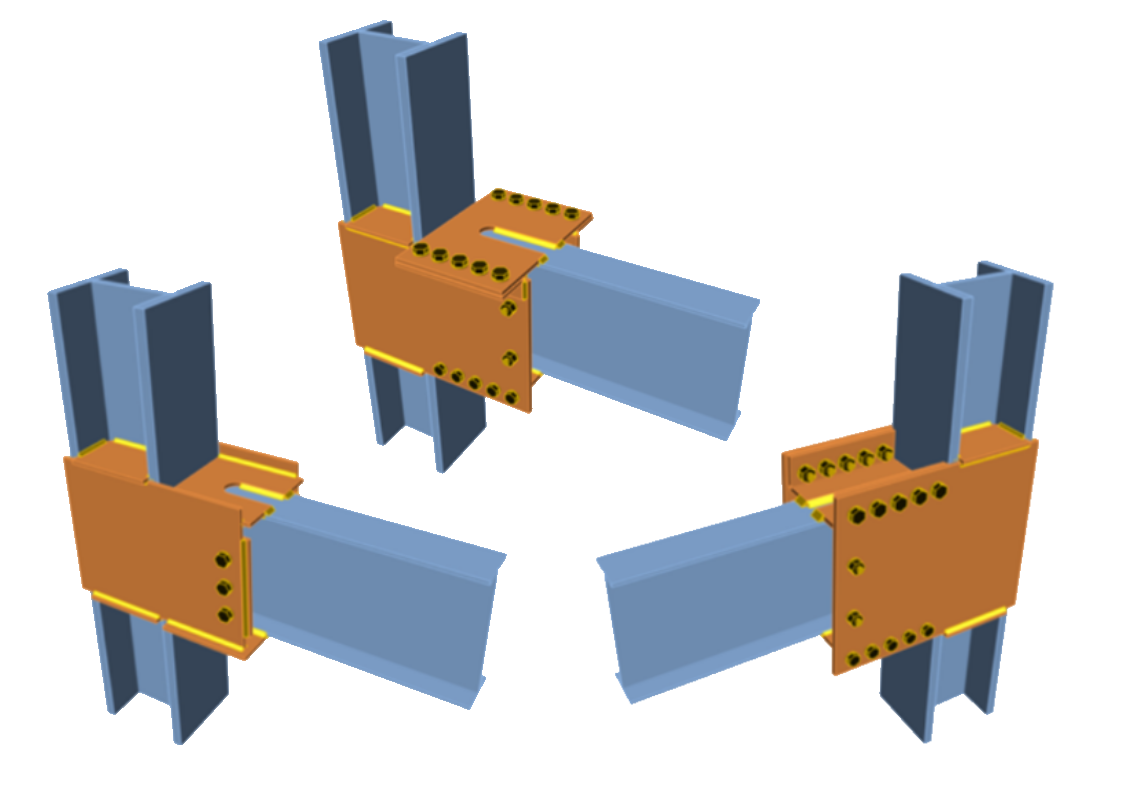
European Seismic Connections
The Equaljoints project, developed by ECCS (European Convention for Constructional Steelwork), aims to establish prequalification criteria for seismic steel connections for the next revision of EN 1998-1. Common European seismic connection types include haunched connections, extended stiffened and unstiffened end plate joints, and dog-bone joints. IDEA StatiCa has participated in this project and verified CBFEM analysis results against experimental data.
Stiffeners
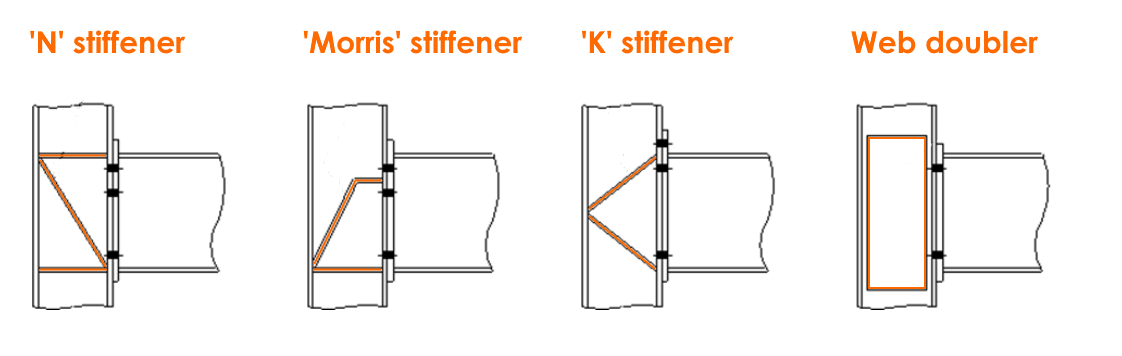
Transferring large bending moments often requires plate stiffeners to maintain force flow continuity. The structure itself may constrain the stiffener placement, or where flexibility exists, the designer can select from a range of arrangements based on engineering judgment and structural efficiency.
Cost Optimization
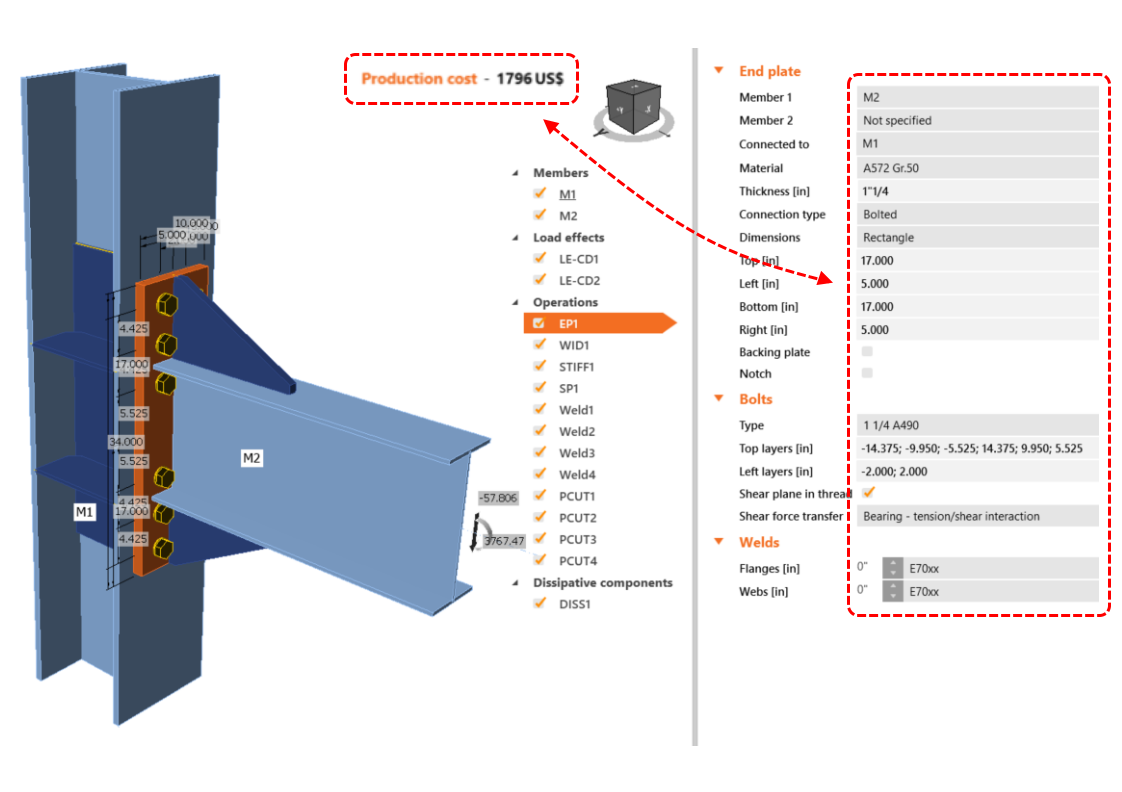
Moment connections are among the most expensive elements of a steel structure when production, transportation, and erection costs are considered together. IDEA StatiCa includes a Production cost calculator that shows immediately how design changes affect the estimated cost, helping engineers select the most practical and cost-effective configuration.
Calculation and Assessment
Many tools provide code-checks for specific moment connection arrangements, but assessing any configuration without restriction requires a different approach. For connections embedded in a spatial structure with multiple members, two options exist. The first is to model the connection as a non-linear shell model in an advanced FEA application, without access to code-checking against a specific standard. The second is IDEA StatiCa Connection, which places no limits on modeling or analysis and generates bolt, weld, and stress-strain checks according to the selected design code within minutes.